Respecting Confidentiality
There's an awkward reality that comes with working as a design consultant in the public sector: much of your most meaningful work stays behind closed doors.
During my time as an interaction designer for a consultancy working with public sector organisations, I was involved in projects that genuinely mattered. Services where users needed to process data quickly and accurately while adapting to new systems ways of working and big digital transformation projects. Every project I worked on had design challenges that meant getting things wrong would have real consequence for people.
I'm proud of all the work I have done, but I'm also not easily able to share while honouring confidentiality agreements.
This had felt like a problem - how can you demonstrate design thinking, when you can't show the designs? Then I realised.. this in itself was a design problem, and I could approach it like one.
Starting with the users
If I'm trying to communicate my value to potential employers, who exactly am I designing for? What do they actually need from a portfolio?
I wrote some user stories to empathise with those who might find themselves land on my portfolio.
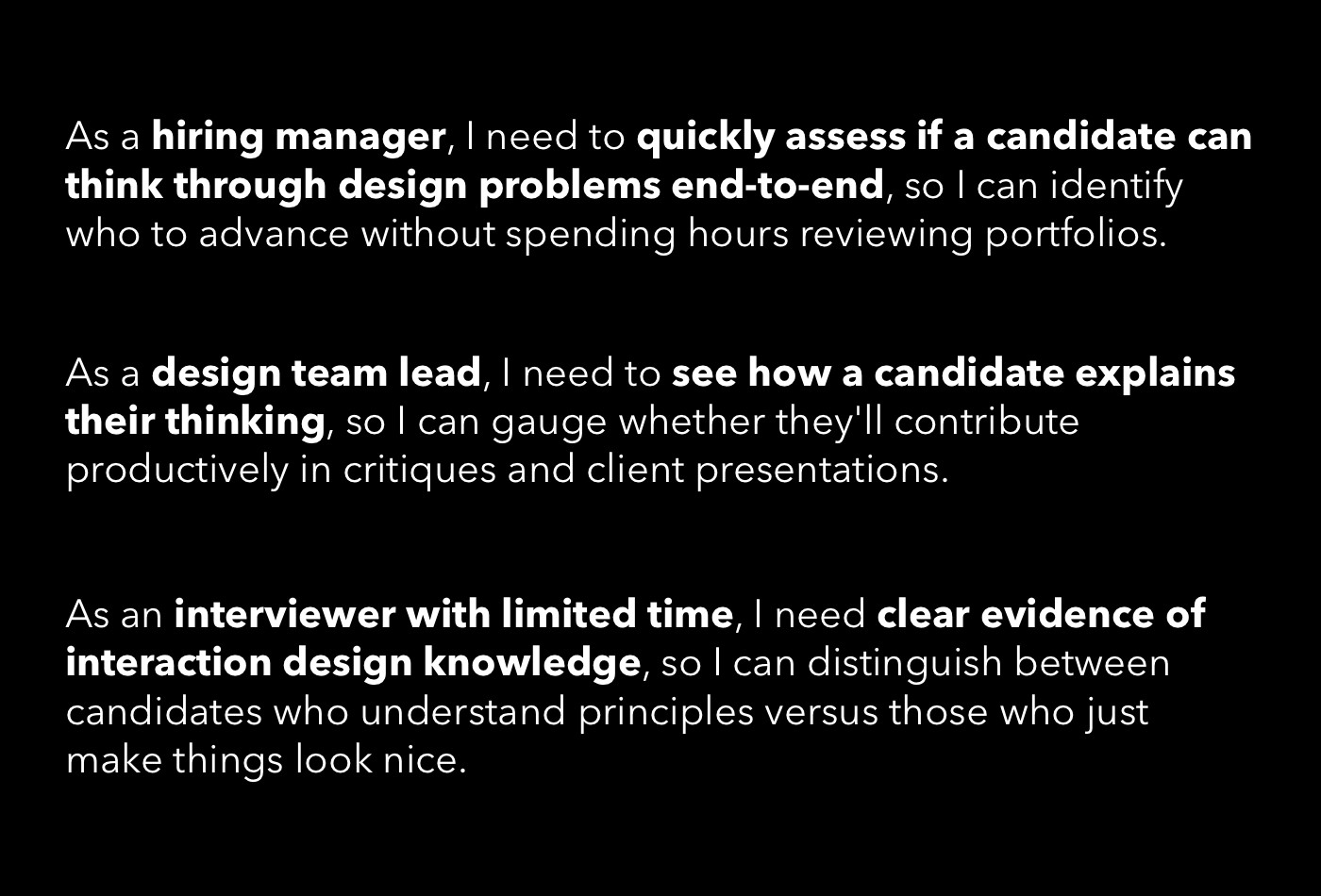
None of these needs specifically require polished final deliverables. It makes sense that hiring managers would want to see evidence that I can frame problems clearly, navigate constraints, explain my reasoning and understand why design decisions matter. I figured this might also mean that the artefacts I create don't necessarily to be from client work. They need to demonstrate the same capabilities I used during client work.
Storytelling
A technique I enjoyed using with clients was storyboarding. When I needed to help stakeholders understand a complex current-state journey or visualise what a future experience could feel like, storyboards cut through in ways documentation couldn't. They can be low effort, high impact. They can help make abstract processes tangible in a format we are familiar with and they stick in people's memories because we’re wired for narrative. Here is one I made to show how I arrived at writing this post.

This storyboard walks through my journey: the initial frustration, the research and eventually landing on an agile approach. Design the smallest possible thing that demonstrates the biggest possible insight.
What I can tell you
While I can't show screen designs, assumption logs, design iterations or blueprints, I can describe the shape of the challenges I worked on.
A digital transformation project meant reimagining how users would engage with material in an entirely different context and format. This involved rethinking interaction patterns, maintaining engagement without familiar supports and designing for a fundamentally changed experience.
Another involved designing for divided attention. We knew users would need to multitask while adopting to a new way of doing things and the interface had to support that cognitive load rather than add to it.
In a different project we were focused on supporting users to get their job done quickly and accurately. The biggest design challenge wasn't changes new system itself, it was ensuring that any changes didn't slow user down or introduce errors to their work.
In each case, the work required the same core skills: understanding user needs under real constraints, making complexity manageable, and designing for the moments that matter most.
Showing the work differently
The select works featured on my portfolio: an airline booking app produced while studying UX and a lite case study showing a move from a mobile browser to app might not feature work that went on to be implemented, but I can show you how I think. I can walk you through how I frame problems, the methods I reach for, and why I believe certain approaches work.
The storyboard above speaks to evidence of exactly what have done for clients: taking a complicated situation and making it understandable through visual narrative. The user stories demonstrate that I start with who I'm designing for and what they genuinely need.
Takeaway
Sometimes respecting confidentiality means finding new ways to make your skills visible. I'd rather show you my thinking than someone else's screenshots.